20 March 2013

Colour in Textiles – a book review

Something different for today – a book review, the first of a three coming over the next week or so.

This one is close to my heart combining history, colour and textiles. 
How perfect is that?

Colour book 3

Colour in Textiles by Susan Kay-Williams (Bloomsbury Press, 2013)  gives an introductory overview of natural and synthetic dyestuffs over time with lots of interesting facts along the way. 

It’s set out in chronological order, starting with “Fragments and Glimpses; dyes from prehistory” and carries out a broad survey of how and why people coloured textiles – mainly in Europe.

After discussing madder, indigo and (roman) purple the second chapter moves into the Dark Ages and a discussion of the influences of Christianity and Islam on textiles and trade.

Chapter three moves to the Middle Ages and discusses the influences of heraldry, the crusades and the rise of blue, yellow and black dyes. 

The book is full of interesting facts such as the effects of the sumptuary laws across Europe, which saw the rise of black dyes (notoriously difficult).  Black became favoured by the merchant classes as it projected an air of status, whilst still keeping the wearer within the law. 
Black was achieved by a laborious under dyeing with madder and overdyeing with tannins such as gall nuts.

Colour book 2

Chapter six discusses the New World dyestuffs – mainly the introduction of cochineal.

Colour book 1

The overview of the history of dyeing continues into the C16th and C17th when dyeing became more scientific leading to the introduction synthetic dyes such as Turkey Red – which, although it had up to 30 stages, was a valuable red dye because it was so colourfast.

There are fascinating snippets of information – Queen Victoria for example, wore a new mauve colour to a wedding and set the fashion for 1859-61.

The final chapter looks at the major dye developments during the C20th and C21st and the impact of world wars on supplies and trade.

The book ends with a discussion of the revival of natural dyeing by todays craftspeople.

Its a very easy to read book, a story more than a textbook and a valuable addition to the library of any dyer, textile artist, historian or crafter.

14 March 2013

Art of the Book

Bit rushed for time this week with studying and building work in the house.
So I’ll point you in the direction of a great introduction here.
Here are some images and some links for you to follow. 
I’ve tried to give you a very quick insight into how the art developed over time.
Folio from an Arabic translation of the Materia Medica. 1224
Opaque watercolor, ink and gold on paper
H: 24.6 W: 33.1 cm
Baghdad, Iraq
File:Al-Jazari Automata 1205.jpg
Al-Jazari: Water-raising-device from al-Jazari's Kitab fi macrifat al-hiyal al-handasiyya (The Book of Knowledge of Ingenious Mechanical Devices, a.k.a. Automata)
The Topkapi Palace Museum, Istanbul, N° A 3472  ca. 1205

File:Al-jazari elephant clock.png
The elephant clock from Al-Jazari's manuscript. 1315
Folio from a Khamsa (Quintet) by Nizami; verso: Khusraw discovers Shirin bathing in a pool1548. Safavid period
Ink, opaque watercolor, silver and gold on paper
H: 31.1 W: 19.7 cm
Shiraz, Iran
At the end of each week we are asked to select a favourite item from the many, varied selection we are asked to look at.  Mine for this last week is from the Adventures of Hamza.  With tales of legendary hero's and … well, adventures! 
The colours are so beautiful and fresh and the detail is exquisite.
Fullscreen capture 11032013 160122.bmp

6 March 2013

Ceramic arts

Just finished studying Islamic ceramics and now I understand the process of creating lusterware and the differences between stone paste and earthenware, the influences of the Chinese arts via the silk route and the Mongol invaders and also the amazing inventiveness of the Islamic artists in both copying and creating new ideas.

Here are just a few of my favourites for you.

Tile

ca. 1525-50
Ottoman period
Stone-paste painted under glaze
H: 27.8 W: 24.4 D: 2.8 cm
Iznik, Turkey

More information here


Tile

ca. 1575
Ottoman period
Stone-paste body painted under glaze
H: 31.3 W: 30.0 D: 2.4 cm
Iznik, Turkey

More information here


If you are near Oxford consider a visit to the Ashmolean Museum or see more on their collection here.

The V&A has as online reading list for ceramics and glass and more dangerously I went on to discover an online reading list for Islamic textiles and dress!  Eeekkk!!!

The book I have on the topic is by the wonderful John Gillow “Textiles of the Islamic World”

Product Details

And other books from my C&G days (when I studied Moroccan and Turkish embroidery as one of my three countries – maybe I should have seen the interest in Islamic Art way back then.  The third country was….. yes, its an easy guess.  India, of course.)


Ottoman Embroidery

Flowers of Silk and Gold: Four Centuries of Ottoman Embroidery

And back to ceramics, there is a great collection in Stoke-on-Trent, you can see online here.
No doubt used for inspiration for the UK market.

This C17th covered bowl was sold at Christies in 2009 for £17,000 from the Ismail Merchant collection (as in Merchant – Ivory films, some of my all time favourites).  You can spend an hour browsing this wonderful collection here.

AN IZNIK POTTERY COVERED BOWL TURKEY, EARLY 17TH CENTURY

27 February 2013

Carpets

More links for you today on carpets.

A lovely intro to the Islamic art style is here on a V&A microsite.

I’ve never found this site before – why do they seem to hide them away?


An introduction to Islamic Carpets can be found here.

Below are a few examples of the very best from the C16-C17th.

"Star Ushak" carpet, Ottoman period, late 15th century
Turkey
Wool (warp, weft, and pile); symmetrically knotted pile

L. 166 in. (421.6 cm), W. 91 1/2 in. (232.4 cm)


My brain is already seeing some of these designs interpreted in a contemporary textile way.
The girls who went to Grasmere will know what I mean…. think J&J…..

Vegetal patterns were seen throughout the areas under study and in pre-Islamic times were very naturalistic, becoming more stylized and abstracted in the 11th-13th centuries then returning to a more naturalistic style - with Chinese influences.  By the early 16th century ornamentation in the Ottoman Empire is naturalistic with tulips, rose buds, carnations depicted.  You can see more on this here. The Mughal empire loved its flowers of course.

A truly wonderful carpet is in the V&A Museum, London. 

Carpet - The Ardabil CarpetCarpet - The Ardabil Carpet

The Ardabil Carpet

  • Iran.ca. 1539-1540 (made)

    Hand knotted woollen pile, on silk warp and weft; asymmetrical knot, open to the left; average of 340 knots per sq. in (average of 5300 per sq. dm)

And if you thought that was good….

Carpet with scrolling vines and blossoms, Mughal period, ca. 1650
Northern India or Pakistan, Kashmir or Lahore

Silk (warp and weft), pashmina wool (pile); asymmetrically knotted pile

L. 163 3/4 in. (415.9 cm), W. 66 in. (167.6 cm)


Can you imagine over a thousand knots per inch?  That’s how some of these carpets are constructed.

14 February 2013

Coincidences?

These silks were part of an order that arrived this week.
The selection is called “Salt Flats” by Mulberry Silks.

DSC_6075

The magazine colours haven’t quite transferred accurately, but the colour matching is astounding.
Both DS and I noticed the match immediately.

Arch silks

12 February 2013

Winter Blues… and oranges

Finally starting to feel like tidying up and getting sorted. 

Ideas for new projects swimming around in my head.

Though still very much in hibernation mode just now.

11-02-13

7 February 2013

Islamic Arts

I am so enjoying this course, (along with Astrobiology and Modern World History via Coursera) its not leaving me much time for the studio, but then its so cold and muddy out there that I am happy sitting inside reading and watching videos with some hand stitching on occasional evenings.

I thought I would start jotting down some good links here, for those who are interested.
For a virtual tour of a classic domed mosque complex in Istanbul go here.  Its is a fabulous website showing the Suleymaniye Complex, built between 1550-7.

A Walking Virtual Tour: The Suleymaniye Mosque - Photographed by Barry Gross and Michael Gross

And then we got to the Mughal art such as the Badshaahi Mosque in Lahore.  The style of the arches, the internal decoration… I don’t know why but I find it so utterly enthralling and beautiful.


Then we were directed to the sub-Saharan African style and I wondered about the fate of this mosque in Timbuktu, with regards to recent events there.


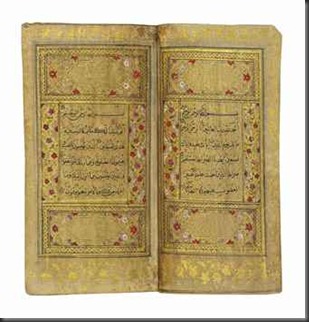
And for a truly beautiful Illuminated Manuscript take a look here


For me the artwork is the important part, not the religion, though of course there is a respect for the importance of this book to the Islamic Culture.  When I head to London in March / April I must go and see this for myself.

I'm always drawn to Mughal ornamentation and for another stunning page look at this image here, click on the image and you zoom in.

The Metropolitan Museum of Art

This is one of my favourite pages.  Reminds me of Elizabethan gardens and embroidery of the time.

MQ1
Christie's | Fine Art Auction House

Next week “Painting and figural representation in Islam”

26 January 2013

Snow!

Tonight its raining hard and I suspect most of the snow will be gone by Monday. 
It's good and bad. 
It will be great to be able to get the car out and go for a good drive.
But I’ve not felt trapped this winter as we’ve been able to get out in (wonderful) Daisy.

Today I finally downloaded my photos from the camera the new laptop.

Now THAT felt good.

15-01-13

Twilight garden.  Can you see the moon?

16-01-13

Hidden becomes revealed.

18-01-13

And boys will be boys – snowdust fights, snowball fights and fantastic sledging.
Its been a good few weeks actually.

Now lets hope it thaws s…l…o…w…l…y.

24 January 2013

Almost back to normal

Hello!

Speaking here from the new laptop at last, the second new one in a week.  I’m now having “great fun” reloading all the software and soon I’ll attempt to reload all my documents and photos.

Today the weather is both drippy and snowy.
Daisy is earning her keep this winter, she handles the snow so much better than we hoped and we’ve not had to dig out the drive and lane, so we are very happy.

IMG_1315

I’ve got lots of plans for new work – presently mulling them over in my mind with the occasional scribble and sketch.  Its something I need to do and it can’t be hurried.

And now I must go as I need to catch up on my online courses – Islamic Art & Architecture (12 weeks, Oxford Uni) and World History since 1750 (15 weeks, Coursera) and AstroBiology and the search for ET life starts on Monday (5 weeks, Coursera).

Bye!

17 January 2013

Hello!

Trying out the Blogger app on the iPad, hoping it works as I have a "slight" Issue with my laptop. I'm hoping to be sorted out in the next few days. Lots of reloading program's and transferring files and folders. It's going to be a long job.

So in the meantime, we'll see how this goes.

Lets try getting a photo into here......

We have more than enough snow up here already and it's seems more to come. So here's a snow photo with a splash of colour and the beautiful orchids residing on my kitchen table which cheer me up several times a day.

Lots of photos on the Nikon, but no way to access them just now.

Now lets see what this blog post will look like.......


6 January 2013

Stone Sculptures at Ingram Valley

617

The whole family joined in. 
Interestingly the DH balanced rocks, I built tall towers and DS built both.
A fabulous afternoon, can’t wait to build more of these.

Stone sculpture Ingram Valley 1Stone sculpture Ingram Valley 8 Ric

Richards tower
Stone sculpture Ingram Valley 15Stone sculpture Ingram Valley 20

DH’s ritualistic balanced stone circle.
Stone sculpture Ingram Valley 32

2 January 2013

Luminous sea

Making the effort to pick up the camera, drive twenty minutes from home and put on wellies.

Debri Spittal Beach

Storm debris washed up on the beach, so much more than ever seen before.
Some beautiful sea-worn sticks to bring home.

spittal beach and sea lighthouse 3

The Breakwater Lighthouse at Berwick-upon-Tweed

spittal beach and sea lighthouse 2

spittal beach and sea 1